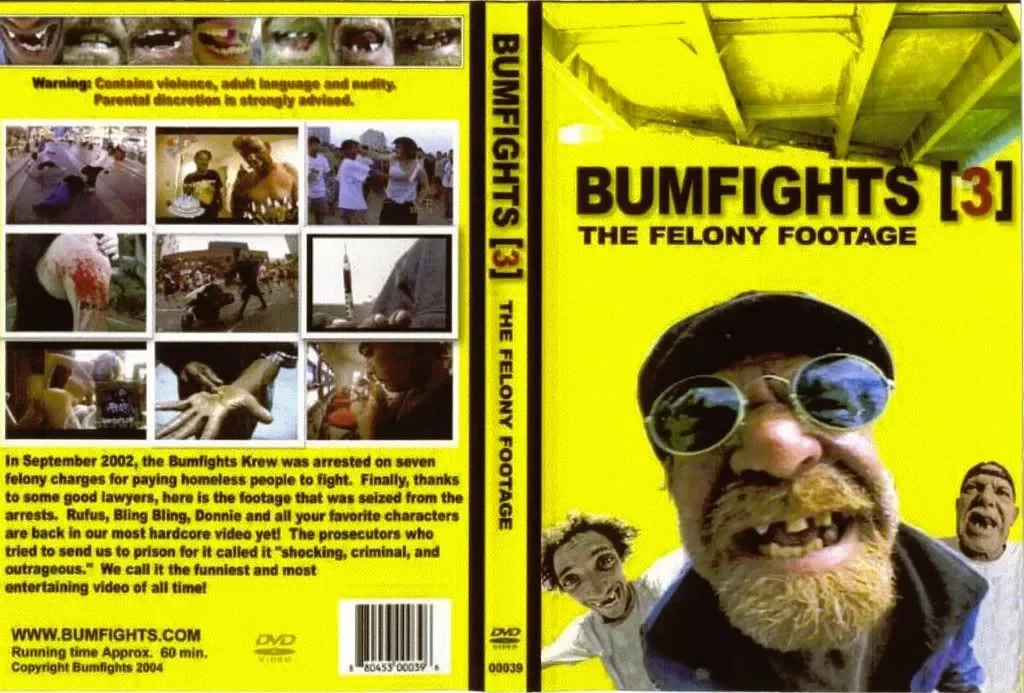
REVISITING BUMFIGHTS and the Dark Side of 2000s Viral Media. Inspired by reporting from Will Howard (2026)

A Cultural Relic We Pretend We Forgot
The early 2000s produced a strange archive of digital artifacts, and few are as unsettling as the phenomenon known as Bumfights. Long before social media algorithms perfected the art of exploiting human suffering, this underground video series demonstrated how easily cruelty could be packaged as entertainment. The project emerged during a time when handheld cameras were becoming accessible, and the internet was still a chaotic frontier with almost no guardrails. What makes the story so disturbing is not simply the content itself, but how quickly it spread and how eagerly audiences consumed it. The videos were passed around like contraband, whispered about in school hallways, and burned onto discs that circulated through dorm rooms. Even now, two decades later, the name triggers a visceral reaction in anyone who remembers the era. Revisiting it forces us to confront the uncomfortable truth that the appetite for spectacle has always been there — the technology just hadn’t caught up yet.
Although the term “bum” is now widely recognized as dehumanizing, the creators leaned into it with full awareness of its shock value. They understood that the word alone would provoke attention, and they weaponized that attention to build a brand rooted in humiliation. The framing was intentionally abrasive, designed to make viewers feel like they were witnessing something forbidden. This wasn’t satire, nor was it social commentary; it was exploitation dressed up as renegade filmmaking. The fact that the series gained traction so quickly reveals how desensitized audiences were becoming to suffering presented as entertainment. It also highlights how little cultural infrastructure existed to challenge or contextualize such content. In many ways, Bumfights was a warning sign of what digital culture would later normalize.
Looking back, it’s tempting to dismiss the entire phenomenon as a relic of a less enlightened time. But doing so ignores the ways in which the same impulses continue to shape online behavior today. The early 2000s were a breeding ground for shock media, and Bumfights simply pushed the boundaries further than most. Its popularity demonstrated that people were willing to overlook ethical concerns if the content felt raw, chaotic, or transgressive. That willingness hasn’t disappeared; it has merely evolved into new forms across modern platforms. The legacy of Bumfights is not confined to the past — it echoes through every viral clip that treats human suffering as a punchline. Understanding its rise helps us understand the digital world we now inhabit.

The Architects of a Controversy
The origins of Bumfights trace back to four young men — Ryen McPherson, Zachary Bubeck, Daniel J. Tanner, and Michael Slyman — who saw an opportunity to capitalize on shock culture. Their project began with a simple formula: find vulnerable individuals, offer them small amounts of money, and record whatever chaos followed. This approach was not innovative, but it was calculated, and the creators understood exactly how to market it. They packaged the footage with aggressive editing, abrasive music, and a tone that suggested rebellion rather than exploitation. The result was a product that felt illicit enough to attract attention but accessible enough to spread quickly. Their production company, Indecline, became synonymous with the series almost overnight. The speed of its rise reflected both the creators’ marketing instincts and the public’s appetite for spectacle.
The first DVD, A Cause for Concern, sold astonishingly well for an underground release. Within months, it moved hundreds of thousands of copies, proving that the creators had tapped into a lucrative niche. The success emboldened them, and they expanded their operation with merchandise, follow‑up videos, and a growing mythology around their brand. What they lacked in filmmaking skill, they compensated for with audacity and a willingness to cross lines others avoided. Their notoriety attracted law enforcement attention, but it also fueled their popularity, creating a feedback loop that rewarded increasingly extreme behavior. The creators seemed to believe they were untouchable, protected by the cult status of their work. In reality, they were building a house of cards that would eventually collapse under public scrutiny.
Eventually, the founders sold the rights to two Las Vegas businessmen, Ray Leticia and Ty Beeson, for a reported $1.5 million. This transition marked a shift from amateur shock content to something resembling a commercial enterprise. The new owners attempted to professionalize the brand, but the core concept remained unchanged: exploit desperation for entertainment. Their involvement did not sanitize the project; if anything, it amplified its notoriety. The sale demonstrated that even the most ethically questionable content could be monetized if packaged correctly. It also revealed how quickly underground culture can be absorbed into mainstream commerce when profit is involved. The shift in ownership did nothing to address the underlying harm — it simply changed who benefited from it.
The Dr. Phil Incident and the Peak of Infamy
One of the most infamous moments in the Bumfights saga occurred when the producers were invited onto Dr. Phil to defend their work. The appearance was intended to be a confrontation, a televised moral reckoning between daytime television and the creators of a controversial underground series. Instead, it became a spectacle in its own right when a man claiming to be Ty Beeson arrived dressed exactly like Dr. Phil, complete with a partially shaved head. The stunt was designed to mock the host and suggest that mainstream media was just as exploitative as the content it condemned. The message was provocative, but it did little to absolve the creators of responsibility. Instead, it highlighted their willingness to escalate the controversy for attention. The moment became a defining image of the franchise’s cultural footprint.
The stunt forced viewers to confront an uncomfortable question: where is the line between exploitation and entertainment? The Bumfights producers argued that reality television profited from similar dynamics, merely dressed in more respectable packaging. While the comparison had some merit, it ignored the fundamental difference in agency between participants. Reality TV contestants, however manipulated, typically enter the process voluntarily and with compensation. The individuals in Bumfights were often unhoused, vulnerable, and desperate, making the power imbalance impossible to ignore. The stunt attempted to blur that distinction, but it ultimately reinforced the ethical gulf between the two forms of media. The public reaction reflected this, with many viewers condemning the producers’ attempt to deflect criticism.
The Dr. Phil incident marked the peak of the franchise’s notoriety, but it also signaled the beginning of its decline. The stunt drew widespread backlash, and the conversation shifted from shock value to accountability. Critics argued that the producers were not rebellious outsiders but opportunists exploiting suffering for profit. The controversy made it increasingly difficult for the franchise to operate without legal or social consequences. As public sentiment turned, the creators found themselves facing lawsuits, investigations, and mounting pressure. The moment that was meant to cement their legacy instead exposed the fragility of their empire. In the end, the stunt became a cautionary tale about the limits of provocation as a business model.

The Digital Mirror We Don’t Want to Look Into
Although Bumfights is often dismissed as a relic of the early internet, its influence lingers in modern digital culture. The same impulses that fueled its popularity now manifest in viral clips that circulate across social media platforms. Videos of street altercations, public meltdowns, and vulnerable individuals in distress routinely rack up millions of views. The difference is that today’s content spreads faster, reaches wider audiences, and is often monetized through algorithms rather than DVDs. The ethical concerns remain the same, but the scale has expanded dramatically. The internet has made it easier than ever to turn suffering into entertainment. In this sense, Bumfights was not an anomaly — it was a precursor.
The persistence of this type of content raises difficult questions about collective responsibility. Viewers may not directly participate in exploitation, but their clicks and shares contribute to its spread. Platforms often struggle to regulate such material, balancing free expression with the need to protect vulnerable individuals. The result is a digital environment where harmful content can thrive despite widespread condemnation. This dynamic mirrors the early 2000s, when Bumfights circulated largely unchecked. The difference is that today’s platforms have far greater reach and influence. The ethical stakes are higher, and the consequences more far‑reaching.
Reflecting on Bumfights forces us to confront the darker side of online culture.
It reveals how easily empathy can be overridden by curiosity, shock, or amusement. It also highlights the need for stronger cultural norms around the consumption of sensitive content. While technology has evolved, human behavior has remained remarkably consistent. The same impulses that drove the popularity of Bumfights continue to shape the digital landscape. Understanding this continuity is essential if we hope to build a more responsible online culture. The past may be uncomfortable, but it offers valuable lessons for the present.

What We Choose to Remember
The story of Bumfights is not just about a controversial video series; it is a reflection of the cultural forces that shaped the early internet. It reveals how quickly harmful ideas can spread when there are no systems in place to challenge them. It also demonstrates how easily vulnerable individuals can be exploited when society fails to protect them. The franchise may have faded from public consciousness, but its legacy persists in the digital habits we have developed. Revisiting it forces us to confront the uncomfortable truth that entertainment often comes at a cost. The question is whether we are willing to acknowledge that cost. The answer is not always encouraging.
Credit to Will Howard for documenting the phenomenon in a way that encourages reflection rather than nostalgia. His reporting highlights the need to examine not just the content itself, but the cultural conditions that allowed it to thrive. By revisiting the story with a critical lens, we can better understand the forces that continue to shape online behavior. The early 2000s may feel distant, but the lessons remain relevant. The digital world we inhabit today is built on the foundations laid during that era. Understanding those foundations is essential if we hope to build something better.
Ultimately, the legacy of Bumfights challenges us to consider what kind of culture we want to create. It forces us to ask whether we value empathy more than entertainment, and whether we are willing to confront the darker aspects of our digital history. The phenomenon may be two decades old, but its implications are timeless. As long as suffering can be turned into content, the questions raised by Bumfights will remain unresolved. The past is not as distant as we like to believe. And the responsibility for shaping the future lies with all of us.